Performance Marketing in Zomato’s Digital Marketing Strategy
In the competitive food-delivery industry, attracting customers is only one part of marketing. Businesses also need to understand whether their campaigns are generating measurable results, yes, such as app installs, orders, website visits, and repeat purchases. This is where performance marketing becomes important.
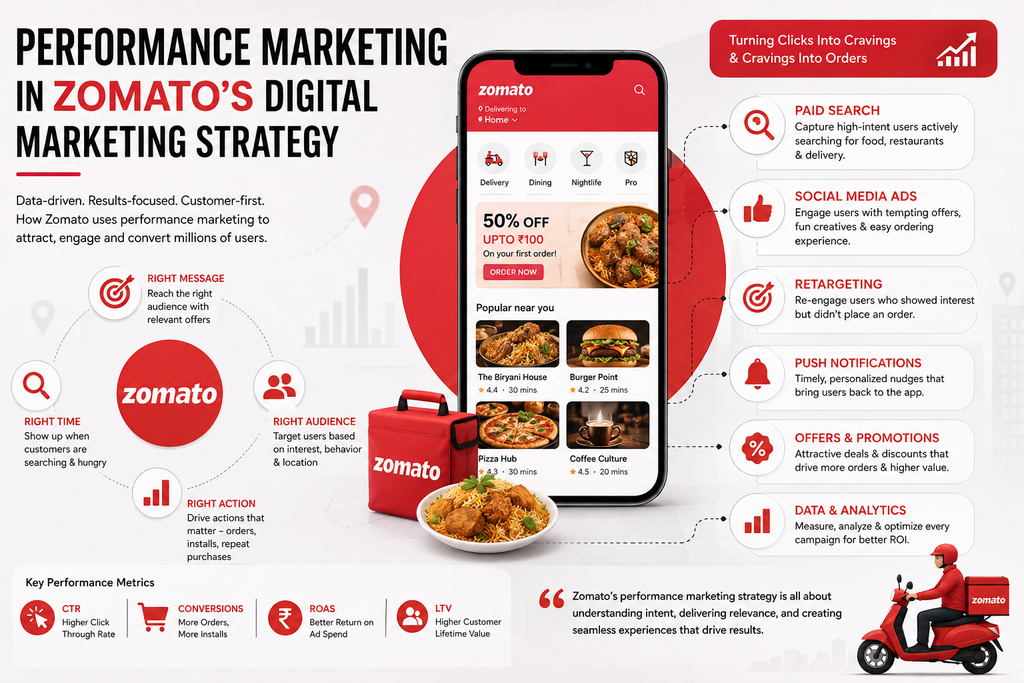
Zomato shows a digital-first business can yes combine ads, personalization, offers, retargeting, and data analysis to encourage customers to act.
What Is Performance Marketing?
Performance marketing is a results-focused approach to digital advertising. Advertisers monitor specific actions generated by campaigns and continuously optimize their marketing based on performance.
These actions can include:
- App installations
- Website or app visits
- Food orders
- New customer acquisition
- Coupon redemptions
- Clicks and conversions
- Repeat purchases
For a platform such as Zomato, the ultimate objective is not simply to make someone see an advertisement. The goal is often to encourage the customer to open the app, explore restaurants, place an order, or return for another purchase.
How Performance Marketing Fits into Zomato’s Strategy
Zomato operates in a highly competitive market where customers can easily compare restaurants, prices, delivery times, discounts, and competing platforms.
Because of this, digital campaigns need to reach people at relevant moments and encourage immediate action. Performance marketing supports this objective by allowing campaigns to be measured and optimized using customer and campaign data.
For example, imagine a customer searches online for food delivery options but does not place an order. A relevant advertisement or offer can later remind that person about ordering food. This creates another opportunity to convert interest into an actual purchase.
1. Paid Search Advertising
Search advertising can play an important role in performance marketing because it reaches users who already have strong intent.
Suppose someone searches Google for terms such as:
“food delivery near me”
“pizza delivery”
“order biryani online”
Advertising around relevant searches can help a food-delivery platform reach customers while they are actively considering an order.
The effectiveness of these campaigns can be evaluated using metrics such as clicks, conversions, cost per acquisition, and return on advertising spend.
2. Social Media Advertising
Social media platforms provide businesses with opportunities to reach audiences based on interests, demographics, behaviors, and previous interactions.
Zomato’s overall social media presence is known for humorous, relatable, and food-focused communication. Performance campaigns can complement this brand-building activity with advertisements designed to generate measurable actions.
For instance, an advertisement featuring a special food offer can include a direct call to action encouraging users to order through the app.
This combination is valuable because entertaining content can build brand familiarity while performance-focused advertising can encourage conversions.
3. Retargeting Potential Customers
Not every person who opens a food-delivery app or visits a website immediately places an order.
Retargeting allows marketers to reconnect with people who have previously interacted with the brand but have not completed the desired action.
Consider a customer who browses several restaurants but leaves without ordering. A later campaign may remind the customer about food delivery or highlight a relevant promotion.
Retargeting therefore helps brands focus marketing efforts on audiences who have already demonstrated some level of interest.
4. Personalized Offers and Recommendations
Personalization is another important element of Zomato’s digital experience.
Different customers have different food preferences, locations, spending patterns, and ordering habits. Showing everyone exactly the same marketing message may therefore be less effective than providing relevant recommendations.
A customer who frequently explores pizza restaurants, for example, may respond better to pizza-related recommendations than an unrelated promotion.
Personalization can make communication feel more relevant and increase the likelihood of customer action.
5. Push Notifications
Push notifications are particularly useful for app-based businesses because they allow brands to communicate directly with existing users.
Zomato is widely recognized for using catchy and conversational notifications designed to bring customers back to the app.
A message arriving around lunch or dinner can remind users about ordering food at a moment when they may already be hungry. Notifications can also highlight discounts, restaurant recommendations, or relevant occasions.
From a performance perspective, marketers can examine how notifications influence app opens, orders, and engagement.
6. Discounts and Promotional Campaigns
Offers can provide customers with an additional reason to complete a purchase.
For example, campaigns may promote discounts, free-delivery opportunities, restaurant-specific deals, or limited-time offers where applicable.
However, successful performance marketing is not simply about offering large discounts. Businesses need to measure whether promotional campaigns are attracting valuable customers and generating sustainable results.
If a campaign costs more than the value it creates, a high number of orders alone does not necessarily make it successful.
7. Data-Driven Campaign Optimization
One of the biggest advantages of digital performance marketing is measurability.
Marketers can monitor campaign performance and identify which channels, audiences, advertisements, keywords, and offers are producing stronger results.
Important metrics can include:
CTR (Click-Through Rate): Shows how frequently people click after seeing an advertisement.
Conversion Rate: Measures the percentage of users who complete the desired action.
CPA (Cost Per Acquisition): Shows approximately how much it costs to acquire a customer or conversion.
ROAS (Return on Ad Spend): Helps evaluate the revenue generated compared with advertising expenditure.
Instead of running the same campaign continuously, marketers can use these insights to test and improve campaigns.
8. Occasion-Based Performance Campaigns
Food ordering is strongly connected to occasions and moments.
Festivals, weekends, sporting events, rainy days, celebrations, and late-night cravings can create additional opportunities for food-delivery marketing.
Zomato’s communication often connects food with everyday situations and popular moments. When this creativity is combined with a clear offer and call to action, a campaign can potentially generate both engagement and conversions.
For example:
“Match night? Your snacks shouldn’t arrive after the final whistle.”
A message like this connects the product with a relevant occasion while encouraging customers to order.
Performance Marketing vs Brand Marketing
Although performance and brand marketing have different immediate objectives, they can work together.
Brand marketing focuses more on awareness, recognition, perception, and long-term relationships. Performance marketing focuses more directly on measurable actions and conversions.
Zomato’s memes, social media conversations, and distinctive communication can help keep the brand memorable. Paid campaigns, retargeting, notifications, and promotional messages can then encourage users to take measurable actions.
In simple terms:
Brand marketing makes customers remember Zomato. Performance marketing encourages them to take action.
What Digital Marketers Can Learn from Zomato
Zomato’s broader digital strategy demonstrates that performance marketing should not operate separately from customer experience and brand communication.
Marketers can learn several practical lessons:
- Understand customer intent before selecting the advertising message.
- Personalize communication whenever reliable customer data makes it appropriate.
- Use retargeting carefully to reconnect with interested audiences.
- Create strong calls to action that clearly tell customers what to do next.
- Track meaningful metrics rather than focusing only on impressions and likes.
- Experiment with campaigns and use results to improve future advertising.
- Combine creativity with data so campaigns remain engaging while supporting business goals.
Conclusion
Performance marketing is an important part of a results-driven digital strategy because it connects marketing activities with measurable customer actions.
In the context of Zomato’s digital marketing strategy, techniques such as paid advertising, retargeting, personalized recommendations, push notifications, promotional campaigns, and data-driven optimization can work together across the customer journey.
Zomato also demonstrates an important marketing principle: performance does not have to mean boring advertising. A company can maintain a recognizable, humorous brand personality while still focusing on conversions and measurable results.
Ultimately, the strongest strategy combines creativity, customer understanding, technology, data, and continuous optimization. For digital marketers, Zomato is a useful case study of how brand communication and performance-focused marketing can complement each other in a highly competitive digital marketplace.