
Digital marketing is not only about creating a website and publishing content. To attract visitors and improve visibility on search engines, businesses also need to build their website’s authority and promote content across relevant online platforms. Two techniques often discussed in this area are backlinks and social bookmarking.
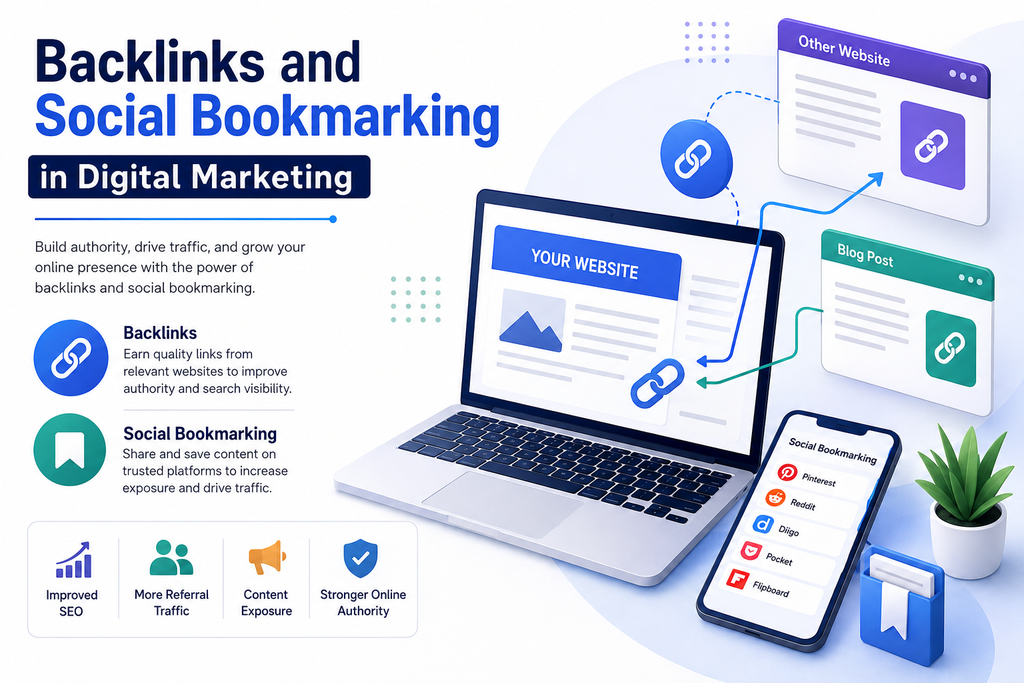
Both can support an SEO strategy when used correctly. However, quality, relevance, and natural promotion matter much more than simply creating a large number of links.
What Is a Backlink?
A backlink is a link from one website to another website. For example, if another marketing blog mentions your article and links to it as a useful resource, your website receives an incoming link.
Search engines can use links as one of many signals to understand the reputation, relevance, and usefulness of webpages. A link from a trusted and relevant website can be more valuable than many links from unrelated or low-quality sources.
Think of it like a recommendation. If a respected website refers its readers to your content, it can indicate that your page contains something useful.
Why Are Backlinks Important?
Backlinks can contribute to digital marketing in several ways.
1. Improve Website Authority
When reputable and relevant websites link to useful content, it can strengthen the perceived credibility of that content. Building authority takes time, so marketers should focus on earning genuine mentions rather than looking for shortcuts.
2. Generate Referral Traffic
Links are not useful only for search engines. People can click them too. If your article is mentioned on a popular industry website, interested readers may follow the link and visit your page.
This type of referral traffic can be valuable because visitors already have an interest in the subject.
3. Help People Discover Content
Publishing an excellent article does not automatically mean people will find it. Links from other websites, communities, directories, and online resources can introduce your content to new audiences.
4. Support Search Visibility
Links are one part of SEO. Relevant mentions from authoritative sources may support a website’s visibility, but they should work alongside quality content, technical SEO, good user experience, and proper on-page optimization.
How to Build Quality Backlinks
The goal should not be to collect as many links as possible. Instead, focus on earning meaningful links from websites related to your industry.
One effective approach is to publish genuinely useful resources. Detailed guides, original research, statistics, infographics, case studies, templates, and tutorials can naturally attract references.
Guest posting can also be useful when the purpose is to contribute valuable information to a relevant website. Businesses can additionally earn mentions through digital PR, partnerships, expert contributions, and industry directories.
Avoid purchasing large quantities of suspicious links or using automated link-building schemes. Such practices can create SEO risks rather than sustainable growth.
What Is Social Bookmarking?
Social bookmarking is the practice of saving, organizing, discovering, and sharing webpages through online platforms or communities.
Instead of saving an interesting webpage only in a browser, users can share or save useful resources on platforms where other people may discover them.
For marketers, these platforms can provide an additional way to distribute articles, guides, videos, infographics, and other useful content.
Benefits of Social Bookmarking in Digital Marketing
1. Content Promotion
After publishing a new blog post, marketers need to promote it. Relevant bookmarking or community platforms can help expose the content to people interested in the same topic.
For example, an article about beginner SEO techniques could be shared within a community where users regularly discuss search marketing.
2. Referral Visitors
If users find a shared resource interesting, they may visit the original website to read more. Therefore, these platforms can become an additional source of referral traffic.
The results depend heavily on the platform, audience, topic, and quality of the content.
3. Faster Content Discovery
Sharing new content across relevant online communities can help it get discovered by users beyond your existing audience. However, social sharing does not guarantee better rankings or immediate indexing.
4. Brand Awareness
Consistently sharing educational and valuable resources can help more people become familiar with a business or website. Instead of continuously promoting products, brands can use these communities to demonstrate expertise and provide useful information.
Backlinks vs. Social Bookmarking
Although the two concepts are connected with content promotion, they are not exactly the same.
A backlink is simply an incoming link from another webpage to your website. It may appear naturally in an article, news story, resource page, directory, or another relevant webpage.
Social bookmarking focuses more on saving and sharing online resources through platforms and communities. Depending on the platform, a shared page may create a link, but that does not automatically make it a powerful SEO link.
Therefore, social bookmarking should mainly be considered a content distribution and discovery technique, rather than an easy method for creating hundreds of links.
Best Practices for Social Bookmarking
To get better results, avoid submitting the same URL everywhere. Choose platforms that have active users and are relevant to your content.
Write clear titles and descriptions that accurately explain what users will find on the page. Participate naturally in communities instead of only posting promotional links. Most importantly, share content that genuinely solves a problem, teaches something, or provides useful information.
Spammy submissions can damage brand credibility and usually provide little long-term marketing value.
How Backlinks and Social Bookmarking Work Together
These strategies can complement each other.
Suppose a business publishes a detailed guide about digital marketing. The guide can first be promoted through relevant communities and content-sharing channels. More people may discover and read it. If bloggers, journalists, creators, or website owners consider the resource valuable, some may reference it in their own content.
In this way, content promotion can increase exposure, while strong content can create opportunities to earn natural links.
Conclusion
Backlinks and social bookmarking can both play useful roles in a broader digital marketing strategy, but they should not be treated as shortcuts to higher rankings.
The strongest approach is to create valuable content, optimize it for users and search engines, promote it through appropriate channels, and build relationships with relevant websites and communities.
Instead of focusing on the number of links created, focus on quality, relevance, credibility, and audience value. A smaller number of meaningful mentions and engaged visitors can be far more beneficial than hundreds of low-quality submissions.
When combined with strong content, on-page optimization, technical SEO, and consistent promotion, backlinks and social sharing can help a website improve its online presence and reach a wider audience.